Two cameras, multiple lenses, small accessories. Clips into the Travel Pack via gatekeepers. Works standalone with a shoulder strap. Kickstarter funded in 5 hours. Shipped to 15+ countries.
Key facts
Most camera cubes carry one body. Photographers with a second body and multiple lenses either carry a separate bag or compromise on gear. The Camera Cube solves that: carry two bodies, multiple lenses, small accessories in one insert that fits the Travel Pack and works standalone with a shoulder strap.
The cube had to secure inside the Travel Pack via gatekeepers, not sit loose, so it doesn't move in transit. It also had to work standalone without the Travel Pack, with its own carry options that didn't bulk when inside the bag.
Material constraint: same DI-TEX 840D Carbonated Nylon as the Travel Pack. The cube reads as part of the family, not an accessory from another supplier.
The gatekeeper system: internal loops on the bag wall, matching attachment points on the cube. When loaded and clipped, it pulls tight against the back panel, doesn't shift even when picked up from one handle or rolled on its side. The positions were designed into the Travel Pack from the start, so integration is structural.
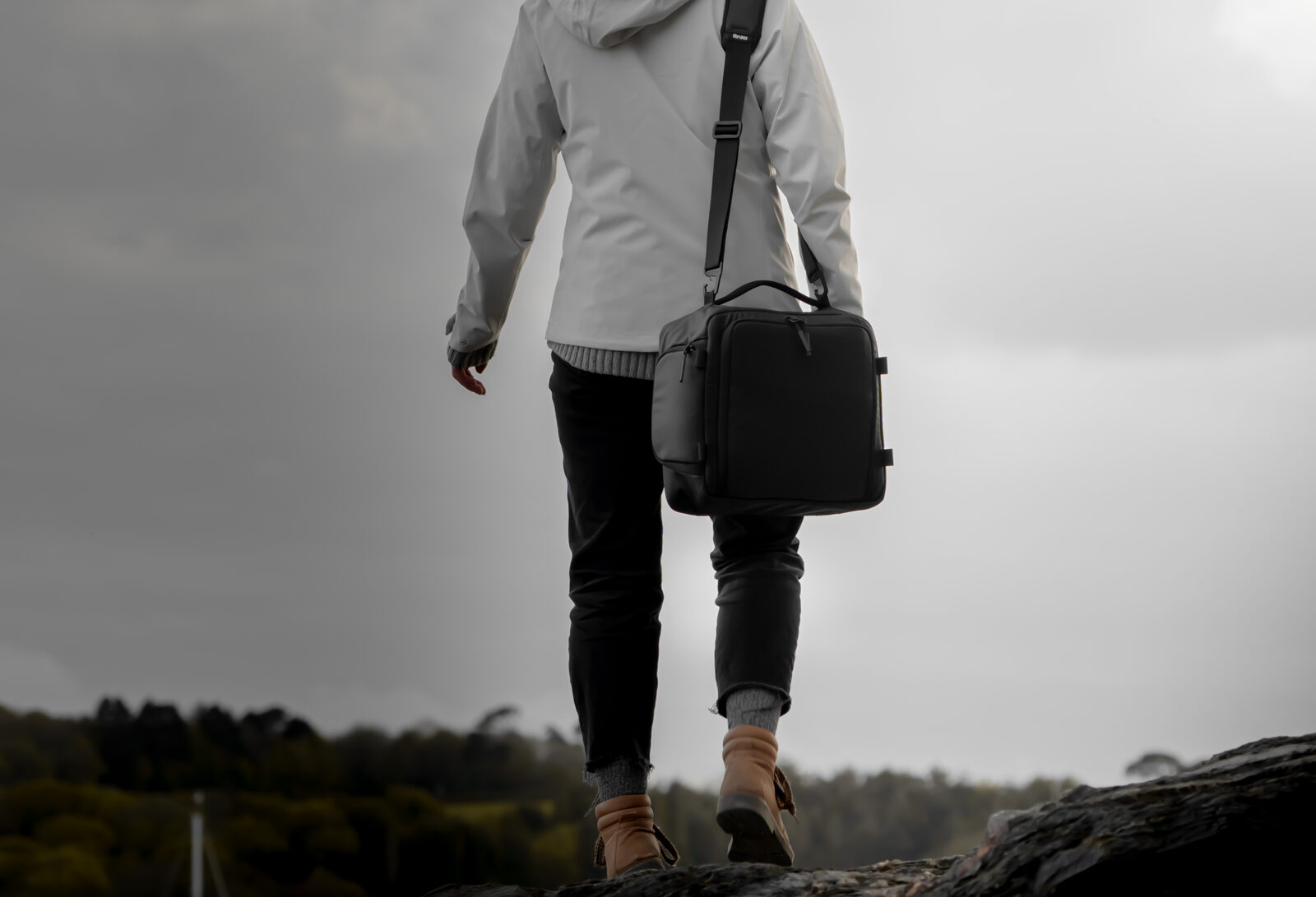
Standalone carry uses a shoulder strap on dedicated lugs on the cube's short sides. Lug positions chosen for where weight sits when loaded with two bodies and lenses. Balance point shifts from empty, and attachment needs to work at full load.
The cube and the Travel Pack were designed together. You can tell when you use them both.
The EVA divider system is reconfigurable by hand: hook-and-loop bases on all dividers, 3mm EVA panels in camera-safe velour. Works for one body and multiple primes as easily as two bodies with zooms. That flexibility lets different shooting styles work rather than optimising for one.
The gatekeeper loops are rated for loaded cube weight over thousands of attach-detach cycles without deformation. Needed specific webbing and bar-tack stitching. Two sample rounds to confirm geometry held under load in the right orientation.
The Camera Cube uses the same DI-TEX 840D Carbonated Nylon shell fabric as the Travel Pack. This wasn't just a cost decision: it was deliberate product family consistency. When the cube is out of the bag on a shoulder strap, it should be identifiable as part of the same system. Same fabric, same colour palette, same hardware finishes.
The interior uses a high-visibility contrast liner in the main compartment. On a shoot, in variable light, you need to be able to locate a specific lens without turning the cube upside down or using a torch. The contrast liner is a functional choice that makes the cube faster to use in real shooting conditions.
The Camera Cube was produced in Vietnam, coordinated with the Travel Pack production to ensure dimensional tolerances aligned across both products. The gatekeeper integration only works correctly if the cube dimensions and the Travel Pack internal attachment positions are both within spec simultaneously. We ran combination fit checks through the production run: cube samples tested inside bag samples at multiple points.
The EVA divider panels are cut and assembled separately and inserted during bag production. Divider panel dimensions are tighter tolerance than the bag shell: if a divider is out of spec, it affects how it sits and whether the reconfiguration works smoothly. Panel dimensions were treated as a critical QC attribute throughout.
Reika Camera Cube
The Kickstarter result confirmed demand for a camera carry product that actually fits inside a travel bag rather than being an alternative to one. Backers in 15+ countries received a product that does what it was designed to do: carry two camera bodies and a lens kit, integrate cleanly into the Travel Pack, and work as a standalone carry when the bag isn't needed.
The gatekeeper integration has had no reported failures in use. Photographers who use the system tend to leave the cube permanently in the bag between trips. That's the indicator that the integration design is right.